

An interior photographer’s kit bag is a wonderful box of tricks but one of the most important pieces of equipment in there is their choice of lenses.
In this post I’m going to take you into my choice of lenses which I take for every interior photography job.


Canon 16-35mm f/2.8 lll USM for interior photography
If I could only have one lens for all my interior photography, then I would choose the Canon EF 16-35 mm f/2.8L III USM
It’s the lens I started out with before I began purchasing any of the specialist interior photography lenses listed below and if you were just starting out on your interior photography journey or your budget is tight then it is the one lens I would recommend you purchasing first.
It gives you a great usable range of 16-35mm on a full frame camera which will allow you to capture great wide angles of almost any room and also get in tighter to capture vignettes and details when needed.
If you’re on a cropped or APSC camera you’ll be looking at a range of around 24-52.5mm. 24mm is considered the golden focal length in interior photography as you’re going to be able to fit most rooms in and also suffer a lot less distortion than going as wide as 16mm.
I wouldn’t recommend going any wider than 16mm for interior photography as it’s going to become to look unnatural and anything closer to the camera is going to suffer from some major perspective distortion, making it look really elongated and much bigger than in real life.
Canon 16-35mm f/2.8 lll USM specifications
Lens construction (elements/groups) – 16/11
No. of diaphragm blades – 9
Minimum aperture – 22
Closest focusing distance (m) – 0.28
Maximum magnification (x) – 0.25
Filter diameter (mm) – 82
Max. diameter x length (mm) – 88.5 x 127.5
Weight (g) – 790


Canon 24-105mm f/4 IS ll USM for interior photography
If there comes a time when you need to get in a little tighter, then the Canon EF 24-105 mm f/4L IS II USM should be the second lens on your shopping list.
Don’t worry about the fact it doesn’t include the wider f2.8 aperture like the much more expensive 24-70mm f2.8. You’re (hopefully) never going to be using that selling point as most of the time you will be on a tripod in the f8-f11 range and I’ve personally not found the jump in image quality to be that great that it demands the extra ~£800.
I would recommend picking up a second hand version of the original copy of this lens if you’re tight on cash.
The mark 2 does include image stabilisation and lets you lock the lens at certain focal points but again the image quality is what we’re concentrating on and you’re not going to get much use out of image stabilisation on a tripod.
Canon 24-105mm f/4 IS ll USM specifications
Lens construction (elements/groups) – 17/12
No. of diaphragm blades – 10
Minimum aperture – 22
Closest focusing distance (m) – 0.45
Maximum magnification (x) – 0.24
Filter diameter (mm) – 77
Max. diameter x length (mm) – 83.5 x 118
Weight (g) – 795

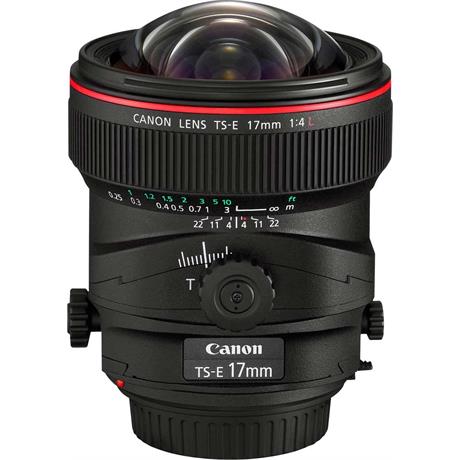
Canon TS-E 17mm f/4 for interior photography
If I could only choose one “specialist” interior photography lens as a present to myself, this would be it.
Once you have taken the jump into tilt shift lenses for your interior photography it will be hard to go back to normal lenses.
They open up a whole new world of technical possibilities and image quality which set the benchmark for interior photography. I have the TS-E 17mm T/S with me at all times when shooting interiors.
It gives me a huge 104° diagonal angle of view and 12° of shift to make sure you really can fit everything in.
The benefits of a tilt shift lens is you can shift the lens up and down so when you have your camera set and level you only need to shift the lens up or down using the knobs on the side of the lens to capture a wider field of view, while keeping all your verticals straight.
If you tried doing the same with a traditional lens by tilting the lens up you would soon end up with wonky walls which can be a pain to fix in post if you’re stripping multiple images together.
The only downside to this lens is that it doesn’t have a filter thread as the front element is HUGE, so you need to buy a specific adapter if you want to be using any filters with it.
I use the LEE Filters Adapter Ring for Canon 17mm TS-E and also find the Lee Filters Wide Angle Lenshood really useful with this lens as it is prone to flare if there is even the smallest bit of light coming from the side.
One thing to note about all tilt shift lenses is they are fully manual focus, so if you’re not comfortable with that, they may not be for you.
Most cameras now have live view which allows you to zoom in and see what you’re focused on or even focus peaking which highlights where your focus is so it shouldn’t be a massive issue for the benefits it gives you.
Canon 17mm f/4 TS-E specifications
Lens construction (elements/groups) – 18/12
No. of diaphragm blades – 8
Minimum aperture – 22
Closest focusing distance (m) – 0.25
Maximum magnification (x) – 0.14
Filter diameter (mm) – 77
Max. diameter x length (mm) – 88.9 x 106.9
Weight (g) – 820


Canon EF 1.4x lll
Here’s where I’ve cheaped out on my kit.
The Canon EF Mark III 1.4x Extender actually works with the TS-E 17mm giving you a poor man’s TS-E 24mm for 1/10th of the price of getting a new lens.
Of course you do lose a stop of light (I don’t think I’ve ever wanted to shoot with this lens at f4 anyway) and the smallest amount of image quality but it’s a great way to get that extra lens in your bag for a relatively small investment.
Canon EF 1.4x lll specifications
Lens construction (elements/groups) – 7/3
Max. diameter x length (mm) –72.0 x 27.2
Weight (g) – 225


Canon TS-E 45mm f/2.8 for interior photography
The Canon TS-E 45mm f/2.8 is a recent addition to my camera bag as I often found myself outside of the reach of the 24mm and wanted the ability to shift the lens which the first two lenses I mentioned don’t offer.
It is an older lens and the build quality is definitely nowhere near the TS-E 17mm but it can also be picked up for near enough a quarter of the price, which – for the technical aspects it opens up – is a steal.
It takes a standard 72mm filter, as well as not requiring a 32” bicep to handhold, so has none of the drawbacks of the bigger TS-E 17mm.
Canon TS-E 45mm f/2.8 specifications
Lens construction (elements/groups) – 10/9
No. of diaphragm blades – 8
Minimum aperture – 22
Closest focusing distance (m) – 0.4
Maximum magnification (x) – 0.16
Filter diameter (mm) – 72
Max. diameter x length (mm) – 81 x 90.1
Weight (g) – 645
What lenses do you have in your interior photography kit bag which you think should make the list?
Drop a comment in the box below if you think there is one I’ve missed.
 Hi, I’m Jak. I’m a photographer based in Manchester, UK who specialises in photographing interiors and architecture.


my client Kasia use Canon TS-E 17mm f/4; we have discussed about it & she informed me about its importance & objective
Yep, it’s a great lens and definitely worth picking up if you’re serious about interior photography.
Is there a lens you’d recommend that would be under $500?
A more affordable option that may not produce top tier quality, but will be able to do an adequate job in most scenarios.
Hi Evan, depends on the system you’re using but something in the 16-35mm range is your best bet.
Hi Jak– Thanks for the very informative article. If you had to choose only one of the tilt shift lenses above, which one would be the most versatile? Doesn’t the TS-E 17mm f4 fall into the fisheye category? Could you describe which types of rooms or shots that are best suited for TS-E 17mm f/4 and TS-E 45mm f/2.8 respectively? Thanks in advance!
Hi Chris, I would go for the 24mm if I’m honest, the 17mm isn’t fisheye but it is VERY wide and you often get issues with things getting distorted towards the edge of the frame.
The 45mm I use for details shots and little vignettes, it’s too tight in to be used for full room shots.
Hi Jak, appreciate this thorough write up. I’m fairly new to architectural photography (at least new to taking it more seriously) and I’ve been considering the Canon R5 with the 24-70 mm F2.8 lens. I read a review of the lens and it mentioned a constant 2.8 F stop so does this mean I cannot shoot at a higher F stop? This does not sound ideal for interior photography. I’m interested in moody imagery with low lighting so the ability to shoot at a low F stop appeals to me but I’d need the flexibility of shooting at different apertures. A bit confused here, as I’m deciding between the 24-105 F4 kit lens and this one. Would appreciate any clarification you can provide
And now after I’ve typed all this it occurs to me it probably means that the aperture remains constant rather than fluctuating as you zoom in and out
Hi Kate, yep you’ve got it!
Some of the cheaper lenses will be something like f2.8-5.6 so as you zoom in the lens lets less light in, both lenses you mention will keep the wide aperture as you zoom.
You will still be able to shoot usually up to about f22 on both lenses.
Great breakdown on lens choices for interior photography! It’s so helpful to know that the Canon EF 16-35mm f/2.8L III USM is a reliable all-rounder, especially for those just starting or working with a tight budget. The advice on avoiding extreme wide angles like 16mm due to perspective distortion really resonates; keeping things natural and true to life is so important in interiors. Thanks for sharing these practical tips—it’s invaluable guidance for anyone looking to up their game in capturing spaces authentically!
Hi Jak,
I am an interior designer and would like to learn interior photography so I can document my work.i am a total novice. Can you suggest a basic kit including lighting and also best learners course for interiors photography?
Thanks
Hey, this post is probably the best place to start but if you have any specific questions drop me an email and i’ll do my best to answer:
https://jakspedding.co.uk/good-beginners-interior-photography-set-up/